UpBlue Collector
What is the Collector?
Machines and PLCs should never be connected to the internet directly. The UpBlue Collector solves this. It is a small program that runs on a PC or server inside your factory network. It reads data from your machines and sends it securely to UpBlue.
The Collector only makes outgoing connections. You don’t need to open ports in your firewall or change anything in your network.
The Collector is designed with the following design philosophy: install and forget. Everything is managed remotely in the UpBlue Management Environment. The Collector itself has no configuration screens.
How does it work?
After installation and pairing, the Collector sets up a connection with UpBlue. Through this connection the Collector receives its configuration. When you send a connection to the Collector in the UpBlue Management Environment, the connection runs locally on the Collector. Connection tests, rule tests and the OPC UA browser also run locally.
The Collector receives values from your machines and sensors. Values are collected in memory and sent to UpBlue every few seconds.
What if the internet is down?
No data is lost. If UpBlue is unreachable, for example because the internet connection is down, all new values are saved to disk. The Collector keeps retrying. When the connection is back, new values are sent first, so your dashboards are up to date right away. The saved values are sent after, in the background.
Firewall
The Collector uses the following external domains. All traffic is outgoing over standard HTTPS ports:
- https://api.upblue.io - Pairing with UpBlue
- https://mqtt.upblue.io - Remote management by the UpBlue Management Environment
- https://stream.upblue.io - Data stream to UpBlue
- https://github.com - For updating the Collector
Install Collector
Windows
The Collector can be downloaded from the collector page within an organisation. Go to the UpBlue Management Environment to open an organisation.
Click on this button in the UpBlue Management Environment: to download the Collector.
To find all releases, go to the UpBlue Collector release page . A Docker image is also available from the same download card.
The Collector can be installed as a service. Only install as a service if you have a good reason to, for example when no user is logged in on the machine. A non-service installation runs as the local user and has no elevated rights in Windows. If you want to change the installation from service to non-service or vice versa, uninstall the Collector and run the installer again.
After installation, navigate to http://localhost:61879/ to open the local Collector page. In a non-service installation, an UpBlue icon will appear in the system tray (next to the time and date). Right click to open UpBlue.
Docker
Docker is a virtualization platform that can run software in so called containers. For Linux, Docker is the way to run the UpBlue Collector.
Find how to install Docker here
Docker compose
After installation of Docker, create a docker-compose.yaml somewhere on your machine:
version: '3'
services:
  upblue-collector:
    image: 'upblueio/upblue-collector:latest'
    container_name: UpBlue-Collector
    restart: unless-stopped
    volumes:
      - upblue_data:/etc/xdg/UpBlue
    ports:
      - 8181:61879
volumes:
  upblue_data:
Open a terminal, go to the folder and run:
docker compose up -d --remove-orphans
The local Collector page is now available on http://localhost:8181/ .
Pairing
The Collector needs to be paired to your organisation before it can send data. Pairing is done with a pairing code. No accounts or tokens are needed.
Open the local Collector page
Open the local Collector page on the machine the Collector is installed on: http://localhost:61879/ . The page shows a pairing code.
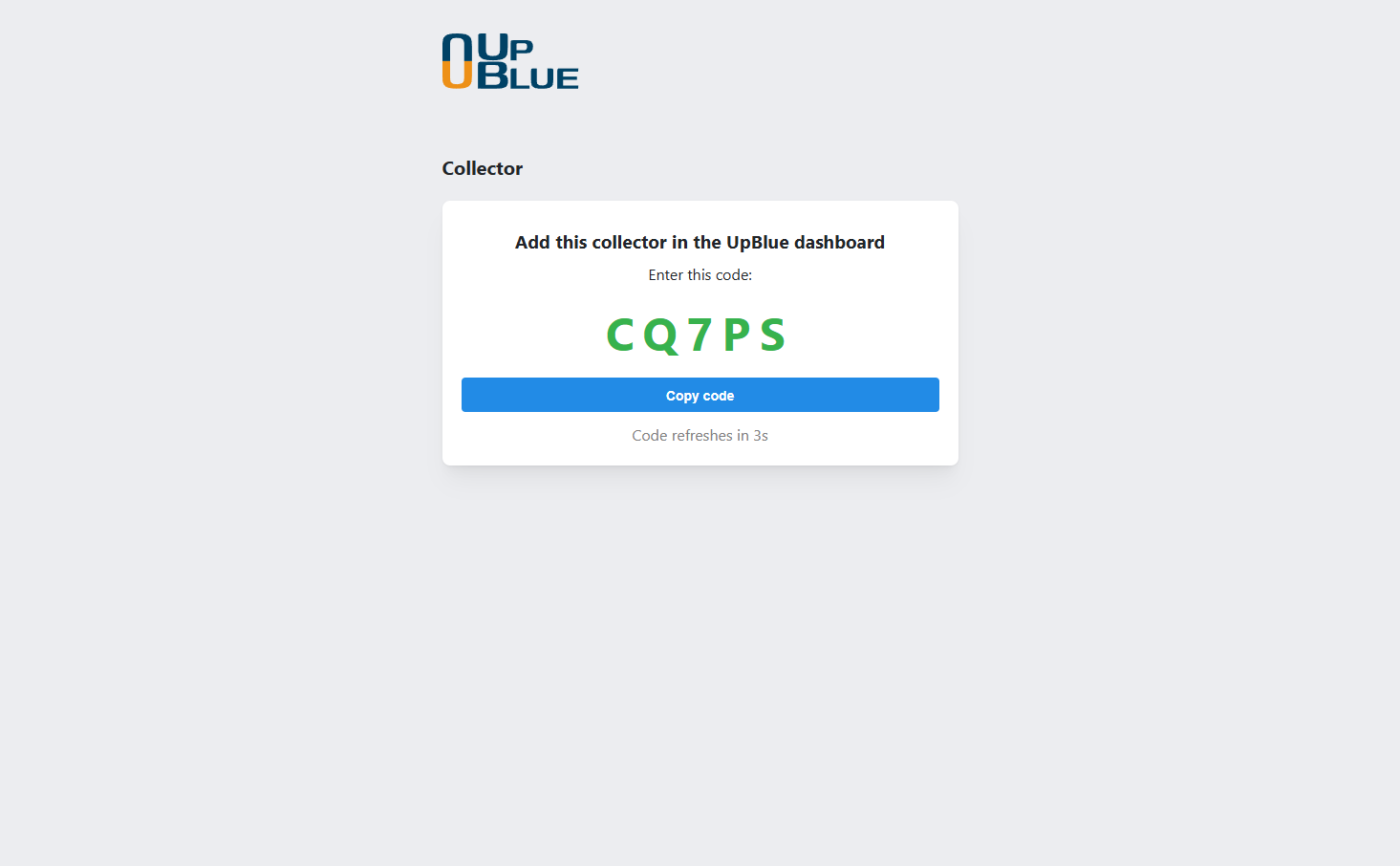
The pairing code changes every two minutes. If a code expired, just use the new code shown on the page.
Add the Collector in UpBlue
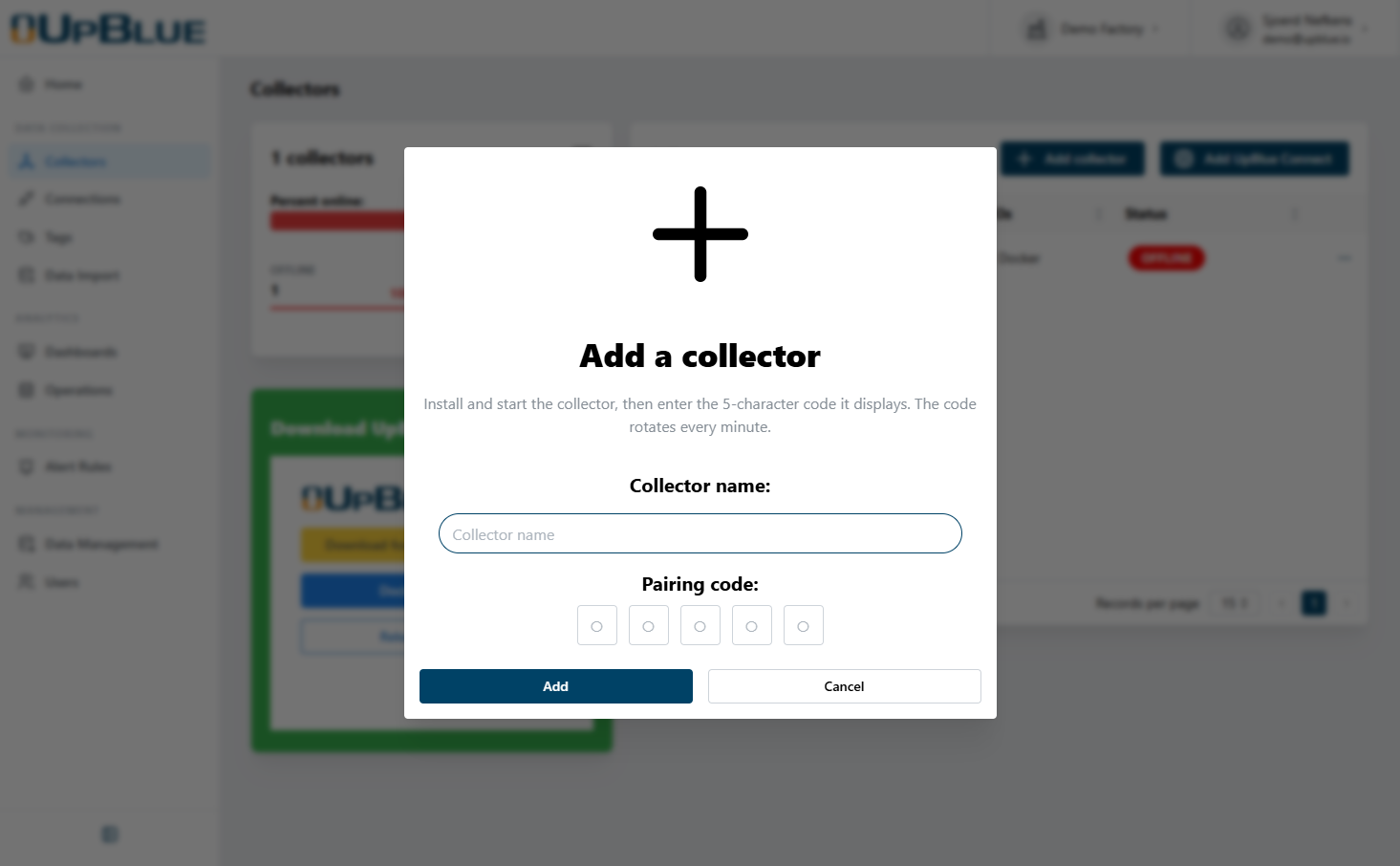
Open your organisation in the UpBlue Management Environment and go to the Collectors page.
Give the Collector a name, for example the name of the site or the machine it is installed near. The name can be changed later. Enter the pairing code.
Done
The Collector is now connected and shows as Online. You can now create connections and send them to the Collector.
Managing the Collector
Everything below is done from the collector page in the UpBlue Management Environment. Open the Collector to see its details.
Status and health
The collector list shows for each Collector its version, operating system and whether it is Online or Offline. The detail page shows CPU, memory and CPU temperature of the machine the Collector runs on. Use this to spot an overloaded or overheating machine before it becomes a problem.
Start and update connections
Use this after changing connections or rules. The progress per connection is shown live.
Update the Collector
The Collector downloads the new version, installs it and restarts itself. No one needs to be on site.
With the “Show Beta releases” switch you can update to a beta version, for example to try a new feature before the official release.
Logs
Open the Logs viewer on the collector page to see what the Collector is doing. This is the first place to look when a connection is not delivering data. The log level can be set to Debug for more detail.
Reconnect, Repair and Reset
These three sound similar but do different things:
| Action | What it does | When to use |
|---|---|---|
| Reconnect | Shows a new pairing code so the Collector can be paired again. | The Collector lost its pairing, or you moved it to another organisation. Connections and settings are kept. |
| Repair | Clears the pairing on the Collector itself, keeping all local configuration. | Pairing is broken and Reconnect does not help. |
| Reset | Factory reset. Stops all connections, clears all configuration and the data saved on disk. | Only when you want to start over completely. |
Reset clears the data buffered on disk. If the Collector was offline and still had data to send, that data is lost.